A Simple Fail
It was only supposed to be a very quick and easy art project that might just take a few weeks…maybe a month. How funny our intentions can turn out to be!
A Simple Fail
A self-deprecating yet appropriate title for a project that I’m extremely proud of!
I did start with very a very simple vision. A riff on a very common tiling pattern that first caught my eye etched into the windows of a local sushi restaurant.


Background
Upon completion of my first project, Adherence, I had the full intention to take a step back and release a "simple" project for my follow-up. I fully believe that simple projects can be just as striking and beautiful as more complex projects. Adherence, while successful, had gotten away from me as I struggled to cram in all of the neat ideas that would continually pop into my mind.
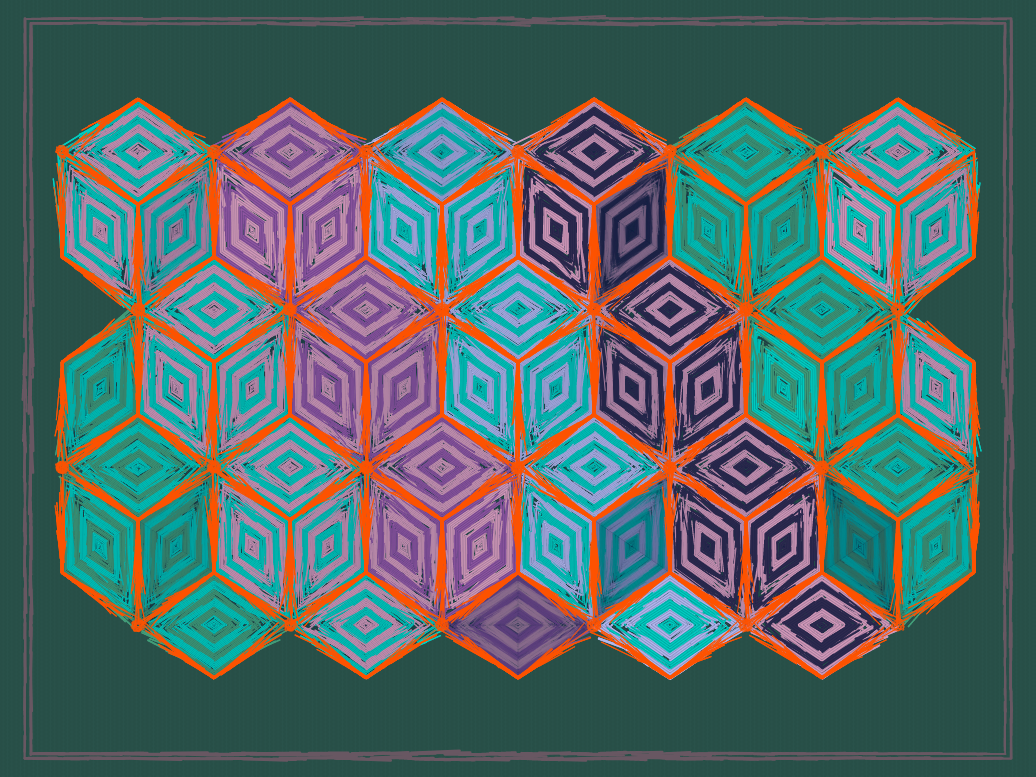
I started by looking for simple inspirations. I took note of several ideas over the next few weeks. One evening, while out to dinner with my family at a local sushi restaurant, I found inspiration in the design they had etched into their windows. It doesn't get much more simple than this; I'm sure you've seen this design several times today! Depending on how you look at the tiling design, you may see stars, triangles, or cubes.
To be honest, I wasn't so sure this would be the foundation of my next project, but I thought it would be fun to see how I would go about coding the recreation of the design. I decided to create a simple grid and calculate the algorithm for determining which points of the grid should be connected to match the pattern. I would then let randomization take part as parameters in the algorithm to mix things up in interesting ways. This worked very well and is still roughly how A Simple Fail is generated.
The Failure
While the foundations are all very basic, I once again failed completely at keeping it simple. I worked on multiple techniques for filling the tile faces. I struggled with different ways to introduce controlled chaos into the project. I developed brand new (for me) methods for drawing imperfect lines, circles, and hatchings. I introduced multiple ways of playing with color throughout the faces of the tiles. With each new element, I did so as if I were just playing around on the P5 Playground. The result was a very unruly code-base which eventually caused me a significant amount of pain. You may be familiar with the programming principle called DRY which stands for Don't Repeat Yourself. Well, I repeated myself.....a lot! Instead of stopping to clean things up, I could only find motivation to immediately improve my outputs. In general, I piled bad code on top of bad code.
What was supposed to be a simple project that I would be able to release in a couple of months at most ended up taking me nearly three quarters of a year to reach the standards of a project that I would be excited to mint as a collector. While the development of this project was a failure in at least one key way, failure isn't all bad. I am thoroughly excited about the quality of the outputs and I hope you will receive the same enjoyment from such A Simple Fail.
-
365 tokens
This project will follow in the footsteps of my genesis by offering roughly the same project size of Adherence. This project is more restrained than Adherence. While I’ve seen thousands of unique outputs during development, I expect that this project size is fully sufficient to show everything this algorithm is capable of.
-
2.34 tz
I had fully intended to price this higher, but we have to be realistic about the state of the market economy. This project is the result in over 6 months of development which I hope is fully appreciated by all of my collectors.
-
One of my biggest objectives for this project was to be more disciplined in the features I would add. To be honest, I thought this objective would allow me to complete this project in just a month or two. Obviously, that didn’t happen as this project has spent over 6 months in development.
While I believe the outputs of A Simple Fail are more focused than those of Adherence, I am forced to admit that the final result of the code base was NOT as clean as I hoped it would be. Instead of a massive improvement, I ended up with just a small step in a better direction. This doesn’t impact the outputs at all, but it did make life more difficult on me during development. I’ll continue to focus on improving my development strategies going forward! -
As I did with Adherence, I won’t be obscuring my code. Anyone is free to use browser dev tools to look and learn to their heart’s content.
Be ye forewarned, though. It’s not pretty. I started out well enough, but little tweaks here and there to play and expand on the project has resulted in a code base I might be a little embarrassed about.
But, that’s OK! We are all in this together and maybe this will be a way of helping others not feel intimidated by a sense of perfection. I have included fairly verbose comments too as added commentary to my insanity.


